


From the zoo to the rainforest: validation of the first radio-tracking harnesses for the Parson’s chameleon
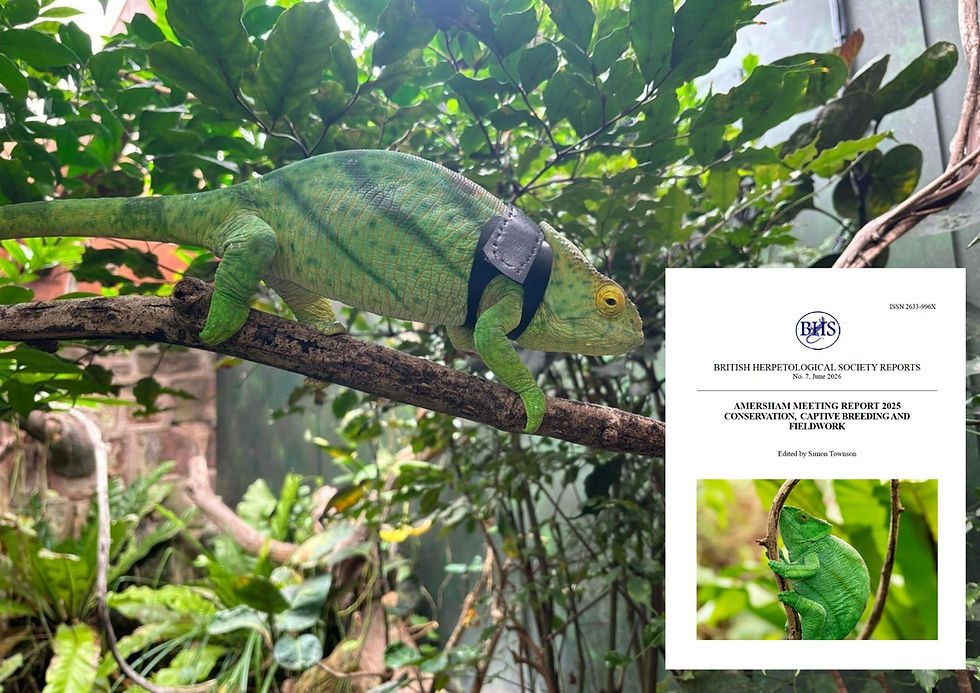
(Photo: Chester Zoo)
The Caméléon Center Conservation is delighted to announce the publication of a new scientific article focusing on the Parson’s chameleon (Calumma parsonii), the world’s largest chameleon species. It details the work that went into developing and validating the first radio-tracking harnesses specifically designed for this iconic species.
This study perfectly illustrates how modern zoos can contribute directly to the conservation of threatened species. Thanks to the expertise of the teams at Chester Zoo and their breeding population of Parson’s chameleons, it was possible to design, test and refine an entirely new methodology before its deployment in the forests of Madagascar.
An unprecedented technical challenge
Understanding the movements and habitat use of the Parson’s chameleon is a major challenge for its conservation. Despite its impressive size and its status as a near-threatened species, very little information exists on its home range, seasonal movements or habitat preferences.

Radio telemetry appears to be a particularly promising tool for addressing these questions. However, no standard solution existed for fitting a species with such a distinctive morphology. The chameleon’s strongly laterally compressed body, its unique locomotion and its arboreal behaviour make the use of systems typically employed for reptiles particularly complex.
Faced with this challenge, teams at Chester Zoo launched a trial programme aimed at designing a system that is reliable, secure and compatible with the animals’ welfare.
The key role of Chester Zoo
Between 2024 and 2025, the zoo’s keepers, biologists and animal behaviourists were involved in the development and evaluation of several harness prototypes. Seven chameleons of different ages were monitored to assess the potential impact of these devices on their behaviour, movement, feeding and reproduction.
(Photo: Chester Zoo)
Two designs were tested: a belt made of beads and a flexible polyurethane harness. The teams at Chester Zoo gradually refined the prototypes, addressed the issues encountered during the initial trials and assessed their suitability for everyday use with the animals.
The results showed that the chameleons continued to behave normally after the devices were fitted. Mating behaviour was even observed in some of the fitted individuals, demonstrating that the harnesses did not interfere with the animals’ natural activities. This experimental phase led to the selection of the polyurethane harness as the most suitable solution before its deployment in the field.
From the zoo to the Vohimana forest
Thanks to the preparatory work, the CCC teams and their partners were able to deploy this technology in the Vohimana reserve in Madagascar in July 2025.
Five wild Parson’s chameleons were fitted with radio transmitters and environmental sensors to track their daily movements and the microclimatic conditions encountered in their natural habitat. This marks the first application of this methodology to wild individuals.
The study thus demonstrates how the knowledge and tools developed within a zoo can be directly transferred to in situ conservation programmes and contribute to improving the scientific understanding needed to protect endangered species.
(Photos: ONG L'Homme et l'Environnement, Day Nabih)
An exemplary collaboration for conservation
Beyond the scientific findings, this publication illustrates how zoological institutions, researchers and local stakeholders can work together effectively.
Without the work carried out by the teams at Chester Zoo, it would have been difficult to envisage the use of radio-tagging on the Parson’s chameleon in a way that respects animal welfare. Thanks to this ex situ development phase, the CCC now has a tool enabling it to study the movements, habitat use and ecology of this iconic species directly within its natural environment.
This approach, which links the expertise of zoos with field research and conservation needs, is now one of the best examples of what a genuine ‘One Plan’ approach can achieve when applied to chameleon conservation.


Comments