


Project 1: In situ ecology
A global approach to the conservation of the world's largest chameleon
A field ecological study of the two subspecies of the Parson’s chameleon
Conducted in the rainforests of Vohimana and Iaroka, this project aims to gain a better understanding of the spatial ecology, movements, home ranges and habitat requirements of the two recognised subspecies of Calumma parsonii (C. p. parsonii and C. p. cristifer).
Using a long-term scientific radio-tracking protocol, two permanent teams of Malagasy students and local guides carry out continuous monitoring of individuals at both sites to generate data essential for the conservation of this species, which is particularly vulnerable to forest fragmentation and climate change.
A groundbreaking scientific approach
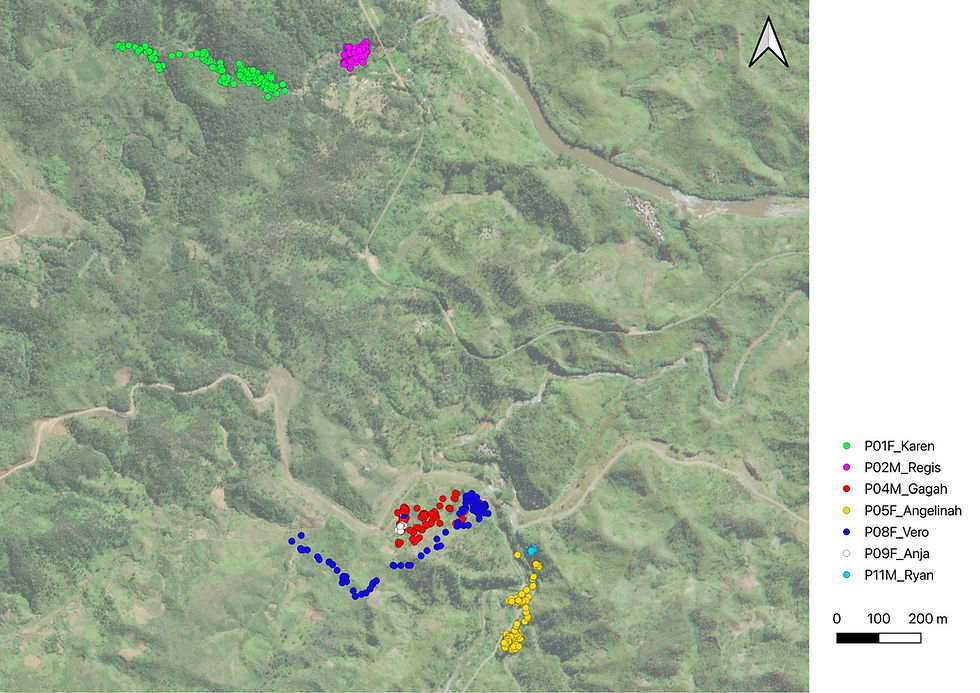
This project is the first long-term study of the ecology of Parson’s chameleon. It compares the two subspecies, Calumma parsonii parsonii and Calumma parsonii cristifer, across two forests in eastern Madagascar. The monitoring programme relies on VHF radio tracking and the continuous collection of ecological data over several years.
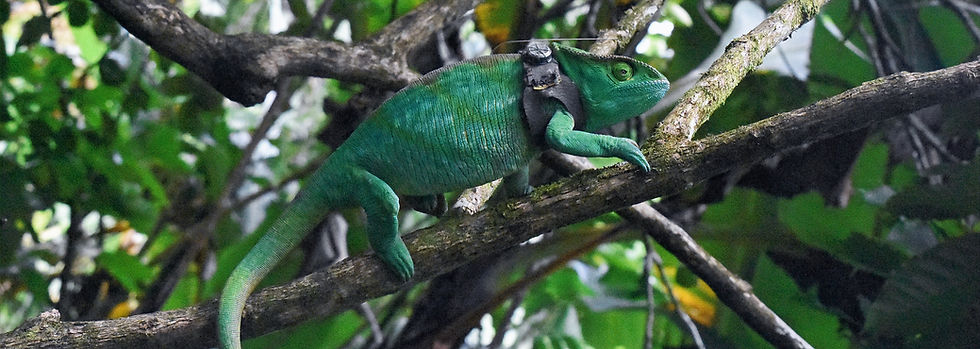
The individuals being tracked are fitted with miniature transmitters to record their movements, home ranges, microhabitat preferences and the environmental parameters to which they are exposed.
This data will provide a better understanding of the species’ actual ecological requirements, enabling the development of practical recommendations for the conservation of Madagascar’s rainforests and the maintenance of ecological connectivity.

Two complementary sites
Vohimana Reserve – Calumma parsonii parsonii
The Vohimana Reserve is the project’s original site. Located in eastern Madagascar, this rainforest is home to a population of Calumma parsonii parsonii. The first group monitored by CCC was fitted with tracking devices there in July 2025. The initial results confirmed the scientific and logistical feasibility of the long-term monitoring protocol. The site is managed by the NGO L’Homme et l’Environnement, a long-standing partner of CCC.



Iaroka Community Forest – Calumma parsonii cristifer
The Iaroka Forest represents the programme’s latest major expansion. Inventories carried out by CCC have confirmed the presence of Calumma parsonii cristifer, a rarer subspecies more closely associated with well-preserved primary forests. In 2026, a second group of individuals was incorporated into the long-term ecological monitoring programme. The site is managed by the Iaroka VOI and the NGO IMPACT Madagascar.


A long-term conservation project
This project is designed as a baseline study to be carried out over several years (2025–2030) in collaboration with local teams and students from the University of Toliara involved in the project.
This long-term approach is essential for understanding the seasonal variations, spatial dynamics and actual ecological requirements of a low-density, slow-growing species such as Parson’s chameleon.
The data collected will contribute directly to the conservation of the rainforests of eastern Madagascar, the improvement of habitat management strategies, the training of young Malagasy scientists and the development of scientific knowledge on one of Madagascar’s most iconic reptile species.
Conservation rooted in the local community
Over 80% of the project’s funding is reinvested directly at a local level, benefiting: Malagasy students, local guides and trackers, and the communities involved in managing the Vohimana and Iaroka forests.
Beyond scientific research, this project thus contributes to the development of sustainable conservation, directly involving local stakeholders at the heart of the ecosystems under study.
Supporting this project means investing in a scientific, ethical and sustainable approach to biodiversity conservation.